Introduction
Precision agriculture is a modern approach to farm management that uses real-time data and advanced technologies to optimize the use of water, fertilizers, pesticides, and other agricultural inputs. The primary objective of this approach is to increase productivity and profitability while reducing resource consumption, production costs, and environmental impacts. Unlike traditional methods, in which all areas of a farm are managed uniformly, precision agriculture relies on site-specific data from different parts of the field to determine where, when, and at what rate each operation should be carried out. In addition to improving yields, this approach contributes to the conservation of natural resources and the strengthening of food security.
The development of precision agriculture began with the use of Global Positioning Systems (GPS) and yield mapping and gradually evolved through technologies such as Geographic Information Systems (GIS), Variable Rate Technology (VRT), remote sensing, and high-resolution satellite imagery. Today, technologies such as the Internet of Things (IoT), Artificial Intelligence (AI), Machine Learning (ML), cloud computing, edge computing, and automated systems enable continuous monitoring, intelligent data analysis, and real-time decision-making.
The effectiveness of precision agriculture is maximized when these technologies interact within an integrated system. In such a framework, sensors collect environmental data, cloud and edge computing platforms process and analyze the information, artificial intelligence algorithms transform the results into management recommendations, and smart machinery and equipment implement these decisions in the field. This integration improves productivity, reduces costs, optimizes resource use, minimizes environmental impacts, and supports the transition toward sustainable agriculture. However, the success of this approach depends on factors such as data quality, the availability of adequate communication and computing infrastructure, interoperability among different systems, cybersecurity, and the economic viability of the technologies involved.
Real-Time Monitoring: The Foundation of Precision Agriculture
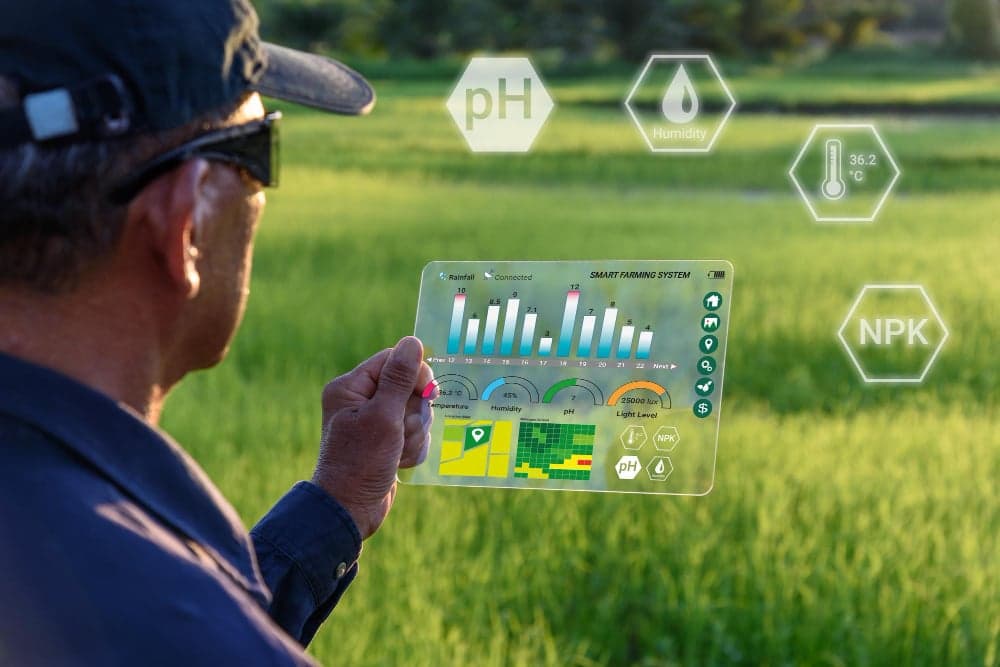
Internet of Things (IoT) sensors are among the most important components of precision agriculture, enabling the collection of real-time data on field conditions. These sensors provide farmers with information about soil conditions, plant health, weather conditions, irrigation, and nutrient levels, thereby supporting more accurate decision-making. For example, soil resistance sensors assess soil compaction and structure, while moisture sensors measure the amount of water available in the soil to determine the appropriate timing and amount of irrigation. The use of these data improves planting, irrigation, and harvesting operations while reducing soil erosion, nutrient losses, and unnecessary water consumption.
Smart field monitoring is not limited to measuring soil characteristics. IoT-based weather stations continuously record data such as temperature, humidity, rainfall, wind speed, and solar radiation, providing valuable information for planning agricultural operations, forecasting weather conditions, and assessing the risk of plant disease outbreaks. In addition, remote sensing technologies such as multispectral and hyperspectral cameras measure indicators including chlorophyll content, canopy temperature, and photosynthetic activity, enabling the early detection of environmental stress, nutrient deficiencies, pests, and plant diseases. Mounting these sensors on drones has also significantly increased the speed and accuracy of monitoring large agricultural areas.
Alongside these technologies, sensors that measure nutrient levels, pH, salinity, and soil gases also play an important role in precise farm management. These sensors continuously monitor the chemical and biological conditions of the soil and provide the information required for targeted fertilization and effective soil management. Variable Rate Technology (VRT) systems also use sensor-generated data to adjust the application rates of water, fertilizers, and pesticides according to the specific needs of different areas of the field. In addition to reducing production costs, this approach helps prevent excessive input use, contamination of water resources, and the unnecessary dispersion of chemicals into the environment.
The efficiency of smart monitoring systems depends not only on sensor quality but also on proper sensor network design and the selection of appropriate communication technologies. Sensors should be deployed across the field in a way that effectively captures variations in soil properties, moisture levels, and plant root zones. Communication technologies, meanwhile, should be selected according to farm size and operational conditions. For example, LoRaWAN is well suited to large agricultural areas because of its long communication range and low energy consumption, whereas Wi-Fi is more suitable for smaller farms or environments requiring rapid data transmission. The use of solar energy sources, low-power batteries, and optimized data transmission methods can further improve the sustainability of sensor networks and reduce maintenance costs, particularly in remote areas.
Data generated by different sensors only realize their full value when they are collected and analyzed within an integrated platform. Data standardization and interoperability among different devices enable seamless information exchange between sensors, machinery, and farm management systems. In this context, edge computing enables rapid data processing close to where the data are generated, while cloud computing provides the capacity required for data storage, complex analytics, and long-term data management. The integration of these two technologies creates an intelligent and reliable infrastructure for data-driven farm management, providing the foundation for faster, more accurate, and more sustainable decision-making in modern agriculture.
Transforming Agricultural Data into Actionable Decisions
Data collected by sensors, drones, satellites, and agricultural machinery only realize their full value when they are effectively processed, analyzed, and interpreted. Cloud computing provides scalable storage capacity and computing power, enabling the management of vast volumes of agricultural data. This technology reduces dependence on local hardware and allows farm managers and operators to access information quickly and remotely.
In smart agricultural systems, data from field sensors, weather information, satellite and drone imagery, and production records are integrated into a unified platform. After being processed through cloud and edge computing environments, these data are transformed into actionable knowledge that supports decisions related to irrigation, fertilization, pest management, planting and harvesting schedules, and other farm management operations. In many advanced systems, these decisions are transmitted directly to smart equipment, allowing field operations to be carried out without continuous human intervention.
Artificial intelligence and machine learning are among the most important technologies used to analyze agricultural data. By utilizing historical yield data, soil characteristics, climatic information, remote sensing imagery, and IoT data, these technologies identify patterns that influence plant growth and predict future crop yields. The results of these analyses help farmers optimize resource allocation, plan production more accurately, and reduce risks associated with environmental variability. However, the accuracy of these predictions largely depends on the quality, diversity, and timeliness of the data used.
Another important application of artificial intelligence is crop health monitoring and the early detection of pests and plant diseases. Images captured by drones, satellites, or cameras mounted on agricultural machinery are analyzed using deep learning algorithms, particularly Convolutional Neural Networks (CNNs), to identify early signs of stress, nutrient deficiencies, pest infestations, or plant diseases. Rapid detection of these problems enables corrective actions to be taken at an early stage, reducing crop losses while also decreasing the use of chemical pesticides and the costs associated with field monitoring.
Machine learning also plays an important role in the development of smart irrigation systems. By integrating data on soil moisture, weather forecasts, evapotranspiration rates, and plant growth stages, these systems estimate the actual water requirements of each field. Algorithms such as Artificial Neural Networks (ANNs), Support Vector Machines (SVMs), and Random Forest can generate optimized irrigation schedules and transmit them directly to automated irrigation systems. This process improves water-use efficiency, reduces resource losses, and enhances crop performance under varying climatic conditions.
Automation, Practical Applications, and Challenges in the Development of Precision Agriculture
One of the most significant developments in precision agriculture is the transition from monitoring and data analysis toward the automated execution of field operations. In this approach, smart technologies are not limited to collecting information; they are also capable of directly implementing management decisions through automated machinery and equipment. Intelligent drones, autonomous tractors, harvesting robots, and automated weeding systems are among the key technologies enabling this transformation.
Agricultural drones equipped with multispectral cameras, thermal sensors, and precise positioning systems can rapidly assess plant health, vegetation density, nutrient deficiencies, pests, and diseases. The information obtained can be used to carry out operations such as fertilization, spraying, and crop growth monitoring with greater precision. Autonomous tractors, on the other hand, use satellite navigation systems, machine vision, and environmental sensors to perform planting, crop management, and harvesting operations with minimal human intervention. The precise movement of these machines not only reduces fuel consumption but also prevents unnecessary field traffic and soil compaction.
Harvesting and weeding robots also play an important role in improving agricultural efficiency. Using machine vision algorithms, these systems can distinguish ripe fruits or weeds from other plants and perform harvesting or weed removal operations with high precision. As a result, crop damage is reduced, the need for herbicides decreases, and the overall quality of the final product is improved.
The primary advantage of automation in agriculture is its ability to increase the precision and speed of field operations while reducing resource consumption. Smart machinery can operate continuously during critical periods such as planting or harvesting seasons and apply inputs such as water, fertilizers, and pesticides only where and in the quantities required. In addition to reducing production costs, this approach significantly decreases the environmental impacts associated with the excessive use of agricultural inputs.
Alongside automated equipment, AI-based decision support systems also play an important role in farm management. By simultaneously analyzing sensor data, drone imagery, weather information, and crop growth conditions, these systems provide recommendations regarding optimal planting times, irrigation schedules, pest management, fertilization, and crop rotation. Connecting these systems to smart equipment enables many field operations to be performed automatically and adjusted according to real-time environmental conditions.
Experiences with the implementation of precision agriculture in different countries have shown that the integrated use of the Internet of Things, artificial intelligence, positioning systems, drones, and automated machinery can increase production efficiency, reduce water consumption and the use of chemical inputs, and improve overall farm management. Technologies such as targeted spraying, intelligent disease monitoring, crop yield estimation, and automated irrigation have also become key components of modern agriculture.
Despite these advantages, the widespread adoption of precision agriculture continues to face several challenges. High initial equipment costs, the need for reliable communication infrastructure, differences in data exchange standards among various devices, limited internet access in certain regions, and the need for continuous sensor maintenance and calibration are among the most significant technical barriers. Furthermore, as the volume of generated data increases, data management, storage, and processing require increasingly powerful computing infrastructure.
At the same time, issues such as data ownership, privacy, and cybersecurity are becoming increasingly important. Information related to soil conditions, crop yields, and farm management represents a valuable asset for farmers, and protecting these data against unauthorized access, data theft, and cyberattacks is an essential requirement for the development of smart agriculture. Therefore, the long-term success of precision agriculture depends not only on technological advancement but also on the development of secure, standardized, reliable, and economically viable infrastructure.
Conclusion
The available evidence indicates that precision agriculture functions as an integrated system in which Internet of Things (IoT) sensors, cloud and edge computing, artificial intelligence, machine learning, robotics, and automation work together in a coordinated manner. Sensors continuously monitor soil conditions, crops, weather, and the farm environment; digital platforms process and analyze the collected data; AI algorithms generate predictions and management recommendations; and automated systems perform operations such as irrigation, spraying, planting, and harvesting. The integration of these technologies improves productivity, reduces resource waste, optimizes the use of agricultural inputs, and supports the transition toward more sustainable agriculture.
Quantitative evidence also demonstrates the considerable potential of these technologies, although their outcomes depend on implementation conditions. In some studies, smart irrigation systems have reduced water consumption by approximately 20–30%, variable rate technologies have optimized fertilizer use by up to 15%, AI-based pest detection systems have achieved accuracy rates of between 85% and 95% in experimental studies, and integrated precision agriculture systems have reported yield improvements of approximately 10%. However, the effectiveness of these technologies varies depending on factors such as crop type, climatic conditions, available infrastructure, the scale of technology implementation, and the local characteristics of each farm.
The future development of precision agriculture is expected to accelerate with advances in technologies such as fifth-generation (5G) communication networks, edge computing, blockchain, advanced sensors, and more accurate artificial intelligence models. High-speed connectivity and local data processing can improve real-time decision-making, while blockchain can enhance data traceability, transparency, and integrity. Furthermore, the development of more accurate, durable, and energy-efficient sensors, together with advances in AI algorithms, is expected to improve the accuracy of predictions, anomaly detection, and decision support. Nevertheless, further research is still required to evaluate the long-term impacts of these technologies on agricultural productivity and sustainability.
Ultimately, the success of precision agriculture depends not only on technological advancement but also on addressing technical, economic, social, and ethical challenges. Developing reliable communication infrastructure, ensuring cybersecurity, improving interoperability among different systems, reducing equipment costs, and expanding farmers’ access to technology and training are among the most important prerequisites for the widespread adoption of this approach. These considerations are particularly important for smallholder farmers and less-developed regions. If these barriers can be effectively addressed, precision agriculture can play a significant role in improving resource-use efficiency, reducing environmental impacts, strengthening food security, and advancing sustainable development in the agricultural sector.
Glossary
-
Global Positioning System (GPS): A satellite-based system used to determine the precise geographic location of people, vehicles, and equipment.
-
Variable Rate Technology (VRT): A technology that adjusts the application rate of seeds, fertilizers, or pesticides according to the specific needs of different areas of a field.
-
Internet of Things (IoT): A network of internet-connected devices that collect, exchange, and manage data.
-
Artificial Intelligence (AI): A technology that enables machines to learn, reason, and make intelligent decisions.
-
Machine Learning (ML): A branch of artificial intelligence that enables systems to learn from data and make predictions or decisions without being explicitly programmed.
-
Cloud Computing: The use of computing and data storage resources over the internet without requiring powerful local hardware.
-
Edge Computing: The processing of data close to where it is generated rather than sending it to centralized servers, helping increase processing speed and reduce latency.
-
Real-Time Monitoring: The continuous collection and analysis of data as it is generated, enabling immediate monitoring and faster decision-making.
-
Multispectral and Hyperspectral Cameras: Imaging systems that capture data across multiple or hundreds of spectral bands, allowing plant characteristics, soil conditions, and environmental stresses to be identified more accurately.
-
LoRaWAN (Long Range Wide Area Network): A low-power, long-range wireless communication technology used to transmit data from sensors and Internet of Things (IoT) devices.
-
Wi-Fi (Wireless Fidelity): A wireless communication technology that enables devices to connect to networks and the internet over relatively short distances.
-
Convolutional Neural Networks (CNNs): A type of deep learning model used to analyze and identify patterns in images and other visual data.
-
Support Vector Machine (SVM): An algorithm used for data classification and prediction by identifying an optimal boundary between different categories.
-
Random Forest: An algorithm based on an ensemble of decision trees that is used for classification and prediction with high accuracy and robustness.
-
Calibration: The process of adjusting and comparing the performance of equipment or sensors against a standard reference to improve measurement accuracy.
Reference:
TY - JOUR AU - Padhiary, Mrutyunjay AU - Kumar, Avinash AU - Sethi, Laxmi Narayan PY - 2025 DA - 2025/07/11 TI - Emerging technologies for smart and sustainable precision agriculture JO - Discover Robotics SP - 6 VL - 1 IS - 1 AB - To maximize agricultural operations and ensure increased productivity, sustainability, and efficiency, precision agriculture makes use of innovative technologies. This review article examines the incorporation of artificial intelligence, machine learning, automation, cloud computing, and Internet of Things sensors as they relate to agrarian engineering. IoT sensors are essential to the collection of real-time data because they offer insightful information about crop status, weather patterns, and soil health. The efficient data processing, storage, and accessibility made possible by cloud computing make scalable and real-time analytics possible. While automation technologies, like robotics and autonomous systems, improve operational efficiency and save labor costs, AI and ML help with predictive analytics, illness diagnosis, and fertilization process optimization. This study showcases case studies that demonstrate how these technologies have been successfully implemented, emphasizing the observable advantages in terms of increased yield, reduced costs, and resource conservation. It also goes into the technological, financial, and privacy issues that come with combining various technologies, it provides information on existing constraints and possible workarounds. In addition, the assessment points out new directions for research, including the deployment of 5G, developments in edge computing, and the creation of increasingly complex AI algorithms. SN - 3059-3204 UR - https://doi.org/10.1007/s44430-025-00006-0 DO - 10.1007/s44430-025-00006-0 ID - Padhiary2025 ER -


